Certified official partners of the most renowned ecommerce solutions.

Toogas-AIP Webinar «Automation and Operational Efficiency in Ecommerce»

- Services
- Implementation of B2B and B2C Ecommerce Solutions
- ERP / CRM / OMS Integration and Automation
- Platform Migration and Upgrade
- Ecommerce Evolution and Support
- Digital Marketing – KPI-Driven
- Analytics, Insights and Data Reporting
- Artificial Intelligence (Agentic AI Ops)
- Ecommerce Audit and Consulting
- User Experience (UX) and Interface (UI)
- PPR Support
- Technologies
- Portfolio
- Clients
- About
- Contacts

How to choose the right ecommerce platform for a scalable digital operation
An ecommerce platform is only one part of the digital operation
When a company decides to invest in ecommerce, one of the first questions that arises is: what is the best platform for selling online?
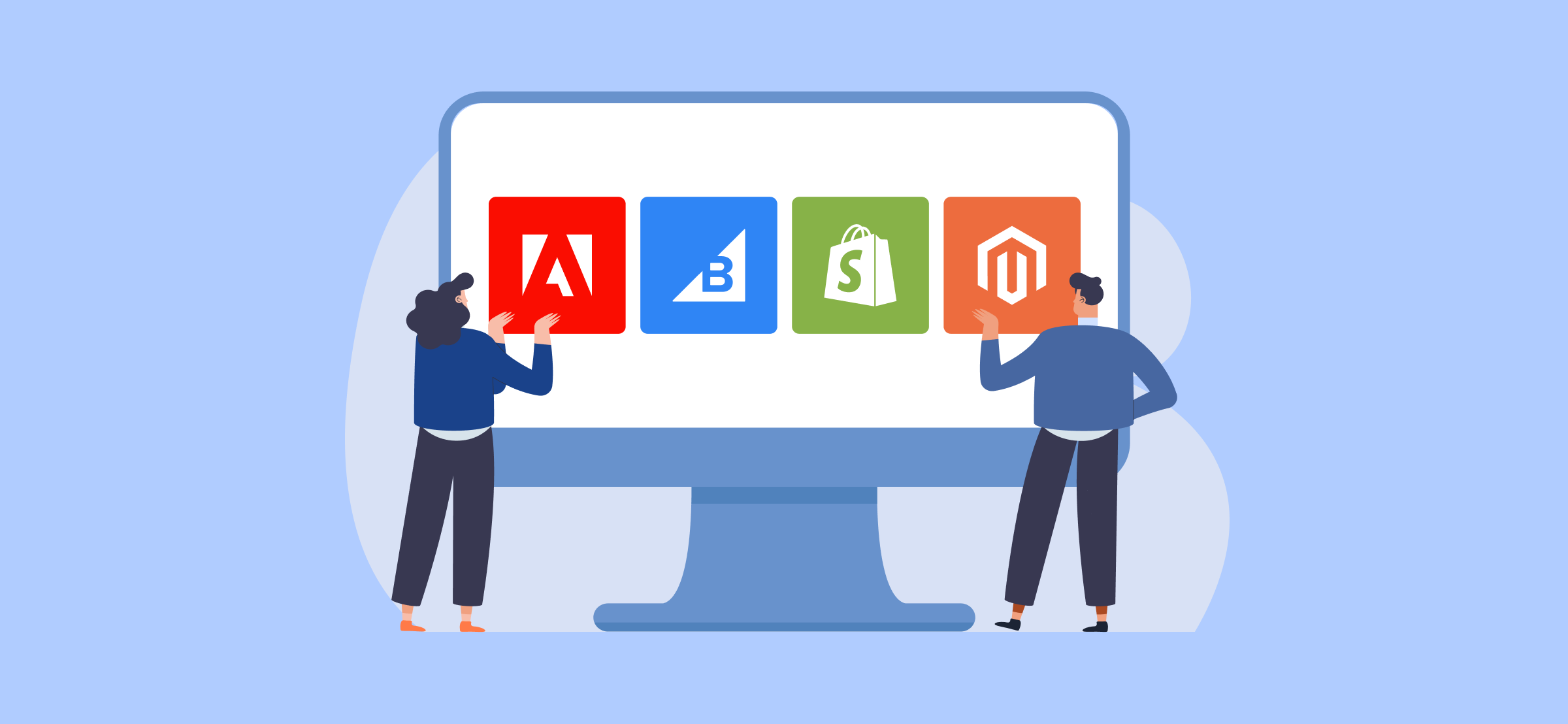
Shopify, BigCommerce, Adobe Commerce, Magento and other solutions frequently dominate market comparisons and analyses. However, for organisations looking to build a sustainable digital operation that is prepared for growth, choosing the platform is only one part of the decision.
The success of an operation does not depend exclusively on the technology used. It depends on how that technology integrates with processes, teams, internal systems, customer experience, data and growth strategy.
For this reason, the more relevant question is not simply which is the best platform, but rather which platform is the most suitable to support the organisation’s current and future objectives.
In this article, we analyse the main selection criteria and explore some of the ecommerce platforms most widely used in the market.
Before choosing a platform, assess the maturity of your digital operation
It is common for companies to begin ecommerce projects focused exclusively on features or costs. However, this approach may create future limitations when the operation starts to grow.
The choice of platform should be aligned with the operational reality of the business and with the level of evolution that will be required over the coming years.
Before making a decision, it is important to assess factors such as:
- Complexity of the commercial operation;
- Integration with ERP, CRM and other internal systems;
- B2B, B2C or hybrid strategy;
- Catalogue and product management;
- Internationalisation requirements;
- Expected transaction volume;
- Requirements for personalising the digital experience;
- Omnichannel strategy;
- Internal capability to manage and develop the platform.
A platform that is suitable today may become a limitation tomorrow if there is no alignment between technology, processes and growth objectives.
1. Shopify: simplicity and speed to accelerate digital initiatives
Shopify has established itself as one of the most popular ecommerce platforms worldwide.
Its main advantage lies in the speed of implementation and ease of use, enabling digital operations to be launched efficiently without requiring large technical teams.
Its ecosystem of applications makes it easier to integrate with different marketing, payment, logistics and operational management tools.
For companies looking to launch or accelerate digital projects quickly, Shopify represents a solid and mature solution.
However, as the operation becomes more complex, it is important to carefully assess specific integration, customisation and technology governance requirements to ensure the platform remains aligned with the long-term strategy.
2. Magento: flexibility and scalability for growing operations
Magento remains one of the leading ecommerce platforms for companies seeking a high level of customisation and the ability to evolve.
Its flexible architecture enables it to support operations with complex catalogues, multiple stores, different markets and advanced integrations with ERP, CRM and other business systems.
For organisations that view ecommerce as a strategic capability, Magento provides the level of control required to adapt the platform to the specific needs of the business.
However, to make the most of its full potential, it requires a specialised technical approach, as well as an implementation and development strategy aligned with the organisation’s growth objectives.
3. BigCommerce: built for growing multichannel operations
As digital operations grow, challenges arise relating to multiple sales channels, systems integration and operational management.
BigCommerce stands out precisely because of its ability to support more complex operations without requiring a high level of technical customisation.
The platform offers robust multichannel management capabilities, enabling marketplaces, social channels and different business systems to be integrated into a more centralised operation.
For fast-growing companies, this integration capability can represent a significant advantage.
4. Adobe Commerce: flexibility for complex enterprise environments
When we talk about digital operations with advanced requirements, multiple markets or complex commercial processes, Adobe Commerce remains one of the leading platforms.
Its architecture makes it possible to develop highly personalised experiences, integrate complex business systems and support large-scale operations.
This flexibility makes it particularly relevant for organisations that view ecommerce as a strategic capability integrated into the business.
Naturally, it is also a solution that requires greater investment, planning and operational maturity.
The real competitive advantage lies in the integration of the digital operation
Modern ecommerce is no longer just an online shop.
Today, a digital operation involves a broad range of systems, processes and teams that need to work together in an integrated way.
The main components of a digital operation include:
- Ecommerce platform;
- ERP;
- CRM;
- Logistics systems;
- Product and catalogue management;
- Marketing automation platforms;
- Analytics and business intelligence;
- Customer experience;
- Payment systems;
- Growth and optimisation tools.
When these areas operate in isolation, scalability becomes difficult.
When they function as part of an integrated architecture, the organisation gains the operational capability to grow sustainably, improve customer experience and increase process efficiency.
It is precisely this integrated vision that makes it possible to transform ecommerce into a true strategic capability for the organisation.
Choosing the right platform starts with understanding the operation
Choosing a platform should be regarded as a strategic decision rather than simply a technological one.
Shopify, Magento, BigCommerce and Adobe Commerce can all be excellent options when they are aligned with the organisation’s digital maturity, business objectives and existing operational complexity.
More than selecting a technology, the challenge is to build an integrated digital operation capable of evolving, adapting and supporting sustainable growth over time.
Because, in the end, the success of ecommerce does not depend solely on the platform chosen. It depends on the organisation’s ability to transform technology, processes, data and customer experience into a truly integrated digital operation.
At Toogas, we help companies design, implement and develop scalable digital operations by aligning strategy, technology architecture, integrations and sustainable growth.
If you are evaluating a new ecommerce platform or rethinking your digital operation, speak to our team and discover the approach that best suits your business objectives.